Shared Signals for Session Revocation

Access may remain even after the conditions that directed it change, even though authentication occurs at a specific point in time. By transmitting changes to the identity and security status of dependent services during an active session, Shared Signals and Continuous Access Evaluation Profile (CAEP) can fill this gap. Instead of waiting for a new login confirmation, the existing policy can take effect immediately.
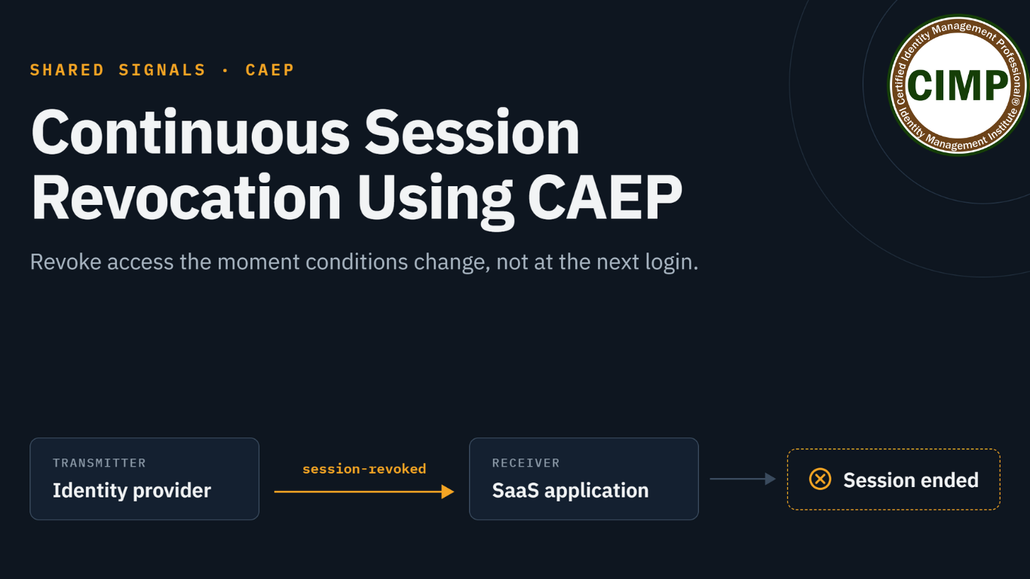
The Stale Session Problem
Without proper management, a previous login can become invalid in as little as a few minutes. Noncompliance with the device, account termination, credential changes, and collecting fresh evidence from a risk system are all potential consequences that might accompany this situation. Downstream applications may continue to rely on the first session until it fails if they do not receive an updated state.
In this case, the problem is less about authentication failure than about permission drift. Even after the circumstances that generated the session are removed, the session produced under acceptable conditions may still be used. Through the use of lengthy token lengths, cached selections, and separate SaaS sessions, that exposure can be prolonged across several companies and services. When the local session state is physically isolated from the identity provider, this information is especially useful.
Continuous revocation treats identity and security changes as asynchronous state transitions. Instead of waiting for another authentication event, a dependent service gets a signal and rechecks the local policy. This lets the service continue running normally. This maintains application control over the reaction while reducing the time between a change in material condition and enforcement. This is where the practical value lies.
Shared Signals Roles And Streams
Shared Signals preserves event generation and event enforcement as distinct. A receiver consumes relevant events, while a transmitter publishes identity or security changes. A stream defines the terms of the exchange between the two parties, including which event types are delivered and which subjects they cover. For continuous access decisions, CAEP establishes event semantics within that framework. Although the transmitter is not serving as a remote authorization engine, a stream may contain information about session revocation, credential changes, or session state. Stream limitations can also restrict the types of security information certain receivers can consume.
This differentiation is important. A security event is a notification that indicates a possible change in status; however, it does not require a specific response from each service upon receipt. When setting its local policy, each receiver considers the risk, the session context, the application’s sensitivity, and the accuracy of the subject identity in the event.
Security Event Token Validation
Other types of security claims, such as Security Event Tokens, require the same level of discipline for signed security statements. A receiver must check the signature, the expected issuer, the intended audience (if present), the authentic signing key, and the required time claims before taking any action to enforce the agreement. Key rotation and identification depend on predictable operation processing.
Verifying the specifics of the occurrence falls to the party that has the information. Before mapping the signal to a local identity, session, or device, the receiver must evaluate the event type, subject identification, and payload structure. Insufficient topic handling may still result in an improper enforcement decision, even if the token is cryptographically valid.
There is a chance that the likelihood of denial-of-service assaults can be reduced by imposing restrictions on replay and source. Session termination should not be a continuous process triggered by repeated occurrences, and access status should not change based on events from sources that cannot be independently trusted. Among the most significant trust challenges associated with event-driven revocation are managing key rotation, idempotent processing, event IDs, and the complexity of setting up the issuer.
Push and Poll Delivery
Push delivery’s reduced latency makes it a popular delivery technique. The enforcement process can begin as soon as the information source detects a change. This is possible because events transfer rapidly from the transmitter to the receiving endpoint. Trade-offs include endpoint availability, retry behavior, queue management, and reliable acknowledgment. Protecting endpoints accessible to the general public and continuously monitoring them is strongly recommended.
Polling results can upset this balance. When a receiver polls for upcoming events on its timetable, it can tighten control over processing speed and reduce sensitivity to incoming traffic. The penalty for conservative polling intervals is additional delay between the source event and local enforcement. This type of delay occurs during the poll.
Neither approach can eliminate the need for failure management. Backlogs, duplicate deliveries, brief outages, and delayed acknowledgments are only some of the unfavorable outcomes that any technique or approach might produce. Permissible revocation delay, recovery behavior, queue depth, and the impact of an event arriving after the local session state has changed are all variables to consider when making architectural decisions.

Session Revocation Semantics
If the application receiving the event can translate the external topic into the proper local session state, then a session-revocation event will be highly useful. This mapping might include account identifiers, session identifiers, cookies, OAuth state, JSON Web Tokens (JWTs), and cached authorization records. Revocation data is less useful when the link between elements is unclear.
Collateral logout happens when the session mapping is too coarse. If an event that specifies a single session is mapped at the account level, it may terminate unrelated sessions. Restricting enforcement to the impacted browser, device, or token set is something that the receiver may do when the local binding is more particular.
Storage overhead can be reduced by using a timestamp-based revocation scheme. Once the receiver establishes the subject’s most recent revocation time, it can reject sessions permitted before that time. With this technique, it must manage clock skew, newly formed sessions, and events that affect only a small fraction of an account’s active access with great care.
Credential Change Propagation
A credential change is not always enough to justify canceling every session immediately. A password reset after a suspected security breach is not the same as enrolling in a routine authenticator, which carries a distinct security connotation. The receiver’s policy needs to differentiate between the type of incident and the risk it carries.
Depending on how much risk the change represents, the system may require reauthentication, terminate the session, or restrict access to sensitive services. Not every change warrants ending all sessions immediately, and a proportionate response avoids disrupting users unnecessarily. Local policy governs these decisions because applications differ in sensitivity, authorization scope, and session duration.
Credential events are dependent on the individual’s configuration. For example, compared to a standard credential update, a recovery flow or authenticator removal may necessitate tougher enforcement. Managing all credential changes in the same way causes more disruption. However, this does not guarantee better control quality or lower the risk of sensitive information leakage.
Device Posture Change Signals
Devices that provide signals can make access decisions beyond the account’s initial state. As soon as the user logs in, a managed endpoint risks losing its compliance status and becoming noncompliant. This can happen because of missing controls, malware detection, policy failures, or loss of management. It must evaluate sessions against the device policy currently in effect while they are operational.
To enforce regulations correctly, it must reliably associate identities with devices. Additionally, the receiver needs enough information to link an event to the correct device and session. Outdated or duplicated device IDs can cause incorrect session termination or missed revocations. When equipment is constantly being replaced, this becomes an exceptionally challenging task.
Collect posture data from a reliable source. Unauthorized client telemetry should not hold the same weight as data management or security services consider trustworthy. Maintaining a deterministic access policy and using a specified precedence model are two methods to resolve conflicting signals when posture sources contradict.

Event Ordering And Race Conditions
Ordering problems can occur when using asynchronous delivery. After a more recent state change, events may be delayed, duplicated, retried, or received out of order. If a receiver processes events only in the order they occur, it may apply information that is no longer current and produce an incorrect session state. Additionally, idempotency helps limit the impact of duplicate actions, while event IDs and timestamps help determine event order.
When many events describe subsequent changes to the same account, device, or session, versioned subject state can provide even more control. Rather than preserving the most recent arrival, processing logic needs to keep the most recent authoritative state.
Because a new session starts immediately after the previous one ends, race management becomes a major focus. To prevent new access from being revoked because of an earlier incident, the enforcement logic must be included. By comparing the session issue time, the occurrence time, and the authoritative current state, it can build a stronger foundation for reconciliation.
Revocation Telemetry and Detection
To substantiate the revocation, it must provide evidence that the enforcement was accepted. A combination of key telemetry is contained in a single traceable sequence connected to each subsequent access attempt, event reception, validation, session lookup, revocation action, and authorization option. Without this connection, effective control and efficient delivery are often confused.
Access succeeding after a valid revocation event indicates an enforcement gap. Access that succeeds after a valid revocation event indicates an enforcement gap. Potential causes include an application route that circumvents revocation restrictions, a mapping failure, an outdated cache, a processing delay, or a gap in enforcement. Direct investigations of these situations ought to be conducted by the operations team.
Both propagation delay and enforcement success may be determined through the use of security monitoring. In a single software system, implementation faults are more likely to cause multiple failures than human error. Correlating signal reception with access after the event is a straightforward method to determine whether continuous access limits are functioning as planned.
Cross-Provider Revocation Architecture
Systems can use numerous software-as-a-service setups. Identity providers, device services, and risk platforms are all examples of organizations that could be considered possible signal sources. Each source also needs a trust scope, expected event types, signature keys, and a well-defined permission boundary to reduce the likelihood that a single provider affects unrelated access domains.
Presenting credentials for each stream limits exposure while maintaining security. Key rotation, issuer validation, and subject correlation must be handled uniformly across providers when multiple IDs apply to the same account or device. Increasing the level of openness in enforcement and reducing the number of misconceptions that occur can be accomplished by adding a layer that is compatible with the internal identity mapping. This should simplify implementation and reduce misunderstandings.
In addition to being aesthetically pleasing, the design needs to be straightforward to understand. If a signal source is lost, the selected visibility and backup options should become active. A temporary access restriction may be enforced, session time may be cut, or session refresh processes may be made more restrictive. Continuous revocation can be far more effective than ever before when signal trust, delivery, mapping, and enforcement act as a single control chain.